
Concrete seems simple on the surface. It is liquid rock, poured into a frame, left to dry, and expected to last a lifetime. But beneath that unassuming grey surface lies a complex chemical process that forgives very few mistakes.
Whether you are dreaming of a sleek back patio, an expanded driveway for your growing family, or a modern concrete walkway to boost your home’s curb appeal, a concrete project is one of the most rewarding home improvements you can make. It adds immediate functionality and strong resale value. However, it is also permanent. Once concrete sets, fixing a mistake often requires heavy machinery, thousands of dollars, and plenty of headaches.
Before you buy a single bag of cement or sign a contractor’s quote, here is everything you need to know to ensure your concrete project turns out smooth, durable, and stress-free.
1. Concrete and Cement Are Not the Same Thing
One of the most common misconceptions homeowners have is using the terms “cement” and “concrete” interchangeably. Understanding the difference helps you communicate clearly with contractors and supplier stores.
Cement is actually just an ingredient. It is a fine gray powder made from limestone and other minerals. Concrete, on the other hand, is the finished building material. It is created by mixing cement with sand, gravel (aggregate), and water. The water triggers a chemical reaction called hydration, causing the mixture to harden and bind everything together.
When you order materials or discuss specifications, remember that you are pouring a concrete slab, not a cement slab. Knowing the distinction ensures you order the right grade and mix for your specific project needs.
2. Preparation Below the Surface Determines Everything
The single biggest reason concrete cracks, sinks, or shifts prematurely has nothing to do with the concrete itself. It comes down to what lies beneath it.
The ground beneath your slab, known as the subgrade, must be thoroughly prepared, leveled, and compacted. Soil naturally expands and contracts with moisture changes and temperature swings. If concrete is poured directly onto loose or soft soil, it will unevenly settle over time, leading to major structural cracks.
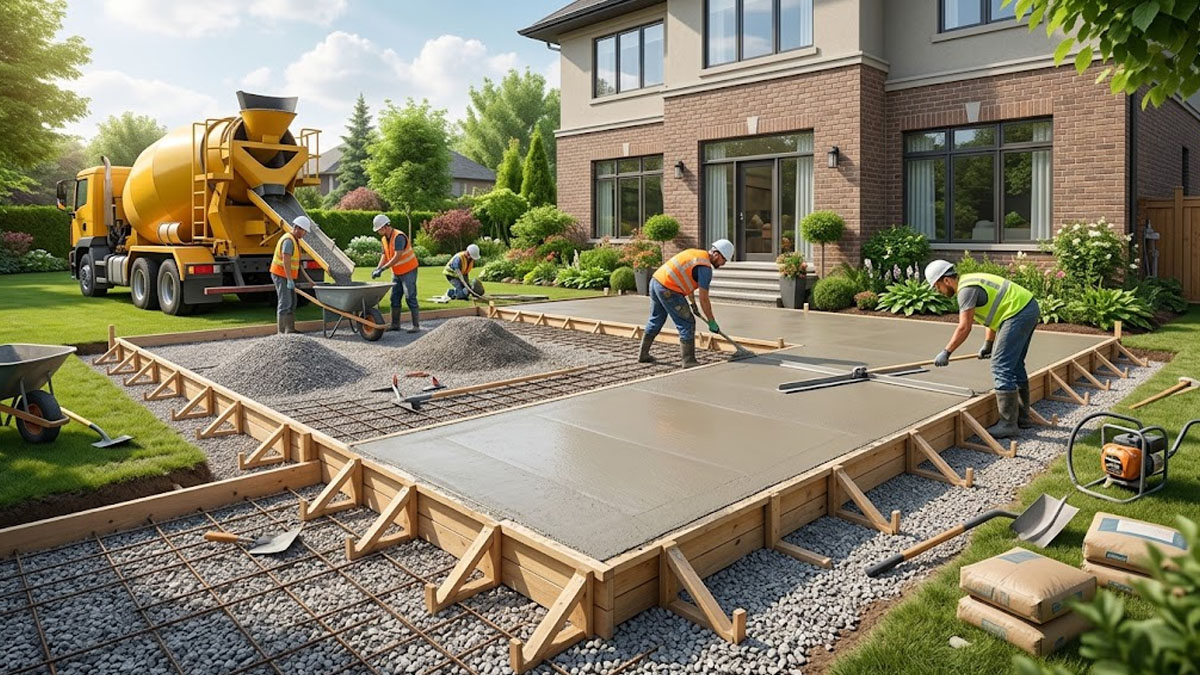
A proper foundation requires excavating to the correct depth, clearing away topsoil and organic debris, and laying down a sub-base—usually four to six inches of crushed gravel or stone. This gravel base provides two essential functions: it creates a solid, uniform surface that distributes weight evenly, and it facilitates proper water drainage so water does not collect underneath and cause soil erosion.
3. Local Permits and Utility Lines Come First
Before any shovels touch the ground, you must address the administrative and safety aspects of outdoor construction.
First, call your local municipality or utility marking service to locate underground lines. Digging into gas, water, electric, or telecommunications lines is extremely dangerous and carries massive repair fines. Most regions offer a free service that marks these utility lines on your property within a few business days.
Second, check with your local government and Homeowners Association (HOA) regarding permits and setback rules. Many cities require permits for projects over a certain square footage, near property boundaries, or involving drainage modifications. Skipping a required permit can lead to costly fines or, in worst-case scenarios, a court order to demolish the newly poured concrete.
4. Drainage and Slope Are Non-Negotiable
Water is the ultimate enemy of home foundations. When planning a concrete surface, you must consider where rainwater and runoff will flow.
Concrete must always be sloped away from your house, garage, or surrounding structures. A standard guideline is a minimum slope of 1/4 inch per foot. This gentle tilt is barely noticeable underfoot, but it prevents water from pooling against your home’s foundation or creating standing puddles on your patio.
If your property has complex terrain, you may need to integrate decorative channel drains or catch basins into your concrete design. Addressing water drainage on paper before pouring is far cheaper than dealing with a flooded basement or water-damaged siding later.
5. Control Cracks Are Essential, Not Optional
Here is an uncomfortable truth every homeowner should accept: all concrete will eventually crack. It is a natural characteristic of a material that shrinks slightly as it dries and cures.
However, professional concrete work controls where those cracks happen. Contractors use control joints—plannings cuts or grooves made into the wet or freshly hardened concrete surface. These joints create intentional weak points so that when the concrete undergoes natural shrinkage or stress, it cracks neatly inside the groove where it cannot be seen.
Ensure your contractor includes control joints spaced at proper intervals, usually no more than two to three times the slab thickness in feet (for example, every 8 to 12 feet for a 4-inch-thick slab).
6. Weather Can Make or Break Your Pour
You can prepare the subground perfectly and buy the best materials, but if you pour on the wrong day, the project can fail. Concrete is highly sensitive to ambient temperature, humidity, and weather conditions during pouring and curing.
- Extreme Heat: High temperatures cause water in the mix to evaporate too quickly. This speeds up the setting time, making the concrete hard to finish properly, and results in a weaker slab prone to surface cracking.
- Freezing Cold: If water inside fresh concrete freezes, it expands and destroys the internal structural bond. Concrete should generally not be poured if temperatures drop below 40°F (4°C).
- Rain: A sudden downpour on freshly poured concrete washes away the top cement paste, exposing aggregate and ruining the smooth finish.
Always check the extended weather forecast before scheduling your pour date, aiming for clear, mild conditions.
7. Curing Takes Time and Patience
Pouring and finishing the concrete is only half the job; curing is what gives concrete its actual structural strength. Concrete does not dry—it cures through a continuous chemical reaction that requires moisture.
While you can usually walk on new concrete after 24 to 48 hours, it takes roughly 28 days to reach its full design strength. Rushing the process by driving heavy vehicles onto a new driveway after a few days will cause permanent structural damage.
To ensure maximum durability, keep the surface moist during the first week using continuous light spraying, wet burlap covers, or a chemical curing compound applied by professionals. Taking time to cure your concrete properly adds years—or even decades—to its useful life.
Final Thoughts
A well-executed concrete project improves your home’s aesthetic, functionality, and market value. By understanding the importance of subgrade preparation, drainage, control joints, and curing time, you can confidently navigate your upcoming project. Take your time during the planning stage, hire a licensed contractor with solid local references, and enjoy a surface built to stand the test of time.
Leave a Reply